
Refrigerant (freon) HFC
R-134a is a hydrofluorocarbon (HFC) used in residential, commercial and industrial buildings for air conditioning, chilling liquids and in heat pumps.
R-134a is a refrigerant used in automotive and agricultural air conditioning systems, medium temperature refrigeration systems, household refrigerators. R-134a is also used to replace R-12 in existing systems.
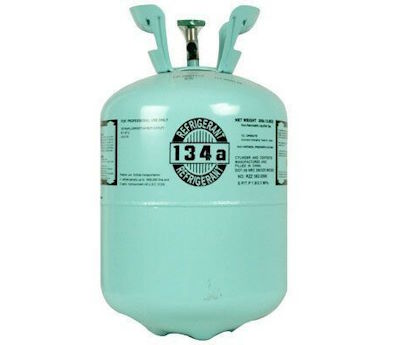
Key characteristics of Freon R134a
| Melting point, °C: | -101 |
| Boiling point, °C: | -26,5 |
| Critical temperature, °C: | 101,5 |
| Critical pressure, MPa: | 4,06 |
| Hazard class: | 4 |
| Mass fraction of tetrafluoroethane, %: | not less than 99.9 |
| Mass fraction of air or nitrogen, %: | not more than 0.02 |
| Total mass fraction of refrigerant impurities, %: | not more than 0.07 |
| Mass fraction of water, %: | not more than 0.001 |
Refrigerant (freon) R-404A
R-404A – a colorless substance, in liquid aggregate state or in the form of odorless gas. It is non-toxic, insoluble in water, but susceptible to organic solvents. It consists of a mixture of HFC refrigerants R143A, R135A and R125A in the ratio: 4:52:44.
The ozone-safe freon R404A is artificially synthesized to replace R502 – it fully corresponds in main qualities, and surpasses the analog in many parameters.
R404A is an active component of refrigeration systems operating in chambers at food production facilities, in the pharmaceutical, chemical, processing industries, as well as in the field of food and flower trading.
Key characteristics of Freon R-404A
| Boiling point at 1.013 bar pressure, °C: | - 46,7 |
| Critical temperature, °C: | 72,7 |
| Critical pressure, MPa: | 3,735 |
| Ozone depletion potential (ODP): | 0 |
| Global warming potential (GWP): | 3750 |
| Hazard class: | 4 |
Refrigerant (freon) R-407C
R-407C is an azeotropic mixture of difluoromethane (R32), pentafluoroethane (R125) and tetrafluoroethane (R134a) (23/25/52%). The freon R407C is widely used in air conditioning systems of low and medium capacity, water chillers and heat pumps.
If necessary, in air conditioning systems it replaces freon R22: the efficiency and performance parameters of these refrigerants are very similar.
R407C is a colorless odorless gas.
Key characteristics of Freon R-407С
| Mass fraction, %:- Difluoromethane (R32) - Pentafluoroethane (R125) - Tetrafluoroethane (R134a): | 232552 |
| Boiling point at 0.1013 MPa, ℃: | - 44,0 |
| Condensation temperature at 0.1013 MPa, ℃: | - 36,8 |
| Critical temperature, ℃: | 86,05 |
| Critical pressure, MPa: | 4,652 |
| Ozone Depletion Potential (ODP): | 0 |
| Global Warming Potential (GWP): | 1370 |
| Hazard Class: | 4 |
Refrigerant (freon) R-410a
R-410a is a near-azeotropic two-component gas mixture (HFC) designed to replace R-22. The freon R410a is designed for charging new high pressure air conditioning systems.
It is used for air conditioners with low energy efficiency and for industrial refrigeration equipment.
Key characteristics of Freon R-410a
| Mass fraction, %: - Difluoromethane (R32) - Pentafluoroethane (R125): | 5050 |
| Boiling point at a pressure of 101,325 Pa (1.013 bar), ℃: | - 52,2 |
| Critical temperature, ℃: | 72,2 |
| Critical pressure, MPa: | 4,95 |
| Ozone depletion potential (ODP): | 0 |
| Global warming potential (GWP): | 1890 |
| Hazard class: | 4 |
Refrigerant (freon) R-507
R-507 is an azeotropic mixture of pentafluoroethane (R125) and trifluoroethane (R143a) in equal proportion. It does not change composition during boiling. In liquid and gaseous states, the equality of components is maintained.
Freon R507 is a long-term environmentally safe exhaustive replacement for R-502 in new low and medium temperature commercial refrigeration systems with evaporation temperatures from -45 to +10°C (supermarket display cases, food storage warehouses, ice making machines and transport refrigeration systems).
Key characteristics of Freon R-507
| Mass fraction, %: - Pentafluoroethane (R125) - Trifluoroethane (R143a): | 50 50 |
| Boiling point at pressure of 101,325 Pa (1.013 bar), ºC: | - 47,1 |
| Critical temperature, ºC: | 71 |
| Critical pressure, MPa: | 3,72 |
| Ozone depleting potential (ODP): | 0 |
| Global warming potential (GWP): | 3900 |
| Danger class: | 4 |
Refrigerant (freon) R-32
R-32 is a hydrofluorocarbon with low GWP (HFC). It is an A2L class refrigerant (slightly flammable) according to EN 378-2017. It has found application in small air conditioning systems (split type).
Freon R32 is a component of many mixed refrigerants. It is the most environmentally friendly compared to analogues. Advantages: low refrigerant charge; high energy efficiency.
Key characteristics of Freon R-32
| Melting point, °C: | -136 |
| Boiling point at a pressure of 101.325 Pa (1.013 bar), °C: | -51,7 |
| Critical temperature, °C: | 78,4 |
| Critical pressure, MPa: | 5,843 |
| Autoignition temperature, °C: | 50 |
| Ozone-depleting potential (ODP): | 0 |
| Global warming potential (GWP): | 580 |
| Hazard class: | 4 |
| Volume fraction of difluoromethane, %: | not less than 99.9 |
| Volume fraction of fluorochloromethane, %: | no more than 0.01 |
| Volume fraction of dichloromethane, %: | no more than 0.01 |
| Volume fraction of air in vapor phase, %: | no more than 1.5 |
| Mass fraction of water, %: | no more than 0.001 |
Refrigerant (freon) R-125
R-125 belongs to the group of hydrofluorocarbons (HFCs) used as a standalone substance or as part of mixtures to replace refrigerants R12, R22 and R502. It has good fire extinguishing properties, which allows it to be used effectively in relevant installations.
It is also used as a refrigerant in reciprocating refrigeration compressors, in its pure form in water-cooled systems, to provide food storage, and in vehicle refrigerators.
Key characteristics of Freon R-125
| Boiling point at a pressure of 101.325 Pa (1.013 bar), ºC: | -48,3 |
| Critical temperature, ºC: | 66,05 |
| Critical pressure, MPa: | 3,592 |
| Ozone depleting potential (ODP): | 0 |
| Global warming potential (GWP): | 2800 |
| Hazard class: | 4 |
| Mass fraction of pentafluoroethane, %, not less than: | 99,9 |
| Total mass fraction of refrigerant impurities, %, not more than: | 0,084 |
| Mass fraction of water, %, not more than: | 0,001 |
Refrigerant (freon) R-152a
R-152a – difluoroethane is a gas at room temperature, but under the pressure created by itself, it turns into a colorless and transparent liquid. It is easily soluble in oil but poorly soluble in water, mainly used as a refrigerant, intermediate refrigerant and raw material for fluororubbers.
R152a is a common component of mixed refrigerants. It is used as a propellant for aerosol packaging, a foaming agent, and serves as a feedstock for vinyl fluoride production. It can be used as an alternative to R134a.
Key characteristics of Freon R-152а
| Boiling point at atm. pressure (101 kPa), °C: | - 24,0 |
| Critical temperature, °C: | 113,3 |
| Critical pressure, MPa: | 4,52 |
| Critical density, kg/m3: | 365 |
| Substance density at 20°C, kg/m3: | 900 |
| Ozone destroying potential (ODP): | 0 |
| Global warming potential (GWP): | 140 |
| MAC of the working area, mg/m3: | 3000 |
| Hazard class: | 4 |
| Mass fraction of difluoroethane, %: | not less than 99.9 |
| Mass fraction of other impurities in total, %: | not more than 0.097 |
| Mass fraction of inert gases, %: | not more than 0.01 |
| Water mass fraction, %: | not more than 0.002 |
| Non-volatile residue mass fraction, %: | not more than 0.001 |
| Acidity: | indicator color does not change |
Refrigerant (freon) R-227ea
R-227ea is a colorless, odorless freon that belongs to the propane series refrigerants. Low in toxicity and non-flammable, it is characterized by zero ozone depletion potential. When the gas is used as a component of mixed freons (in the temperature range from -40 to +100°C and up to a third by mass), it mixes with ether oil.
R227ea is used in air conditioning equipment and in heat pumps operating at high temperatures, as well as for thermal sensors.
Key characteristics of Freon R-227ea
| Boiling point at 101325 Pa pressure, °C: | - 18,3 |
| Critical temperature, °C: | 103,5 |
| Critical pressure, MPa: | 2,95 |
| Ozone depletion potential (ODP): | 0 |
| Global warming potential (GWP): | 3300 |
| Hazard class: | 4 |
| Volume fraction of heptafluoropropane, %: | not less than 99.6 |
| Volume fraction of organic impurities, %: | not more than 0.2 |
| Volume fraction of air, %: | not more than 0.1 |
| Mass fraction of non-volatile residue, %: | not more than 0.001 |
| Mass fraction of water, %: | not more than 0.002 |
| Acidity, parts per million, maximum: | 1,0 |